Your guide to treatment, healing and looking after your skin.
At Amara Laser and Beauty Clinic, we believe that successful treatment starts with the right advice, professional assessment and excellent aftercare.
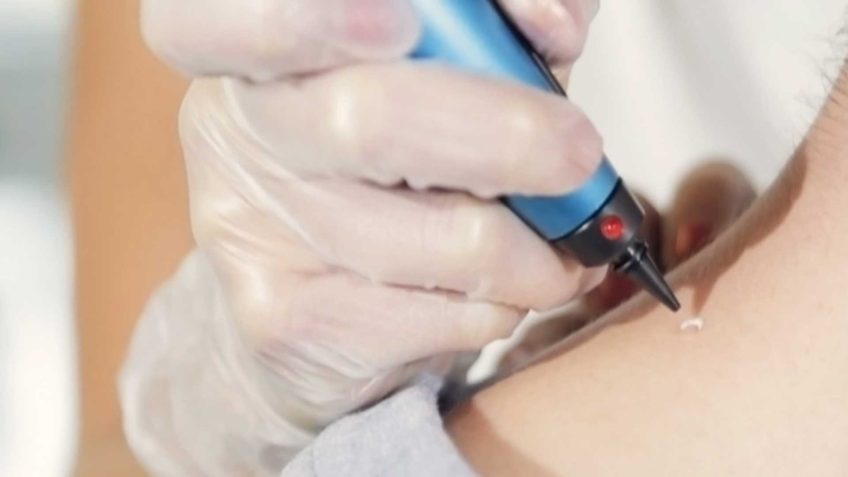
CryoPen is a precision cryotherapy treatment that uses a controlled jet of nitrous oxide (N₂O) to rapidly freeze selected unwanted skin tissue. It allows us to target specific areas with precision while minimising exposure to the surrounding healthy skin. We use CryoPen to treat selected benign skin lesions following an individual assessment by your practitioner.
Below, you’ll find everything you need to know about preparing for your appointment, what to expect during treatment and how to care for your skin afterwards.
What Can CryoPen Treat?
Depending on the type, size, location and characteristics of the lesion, CryoPen may be suitable for:
- Skin tags
- Milia
- Cherry angiomas (blood spots)
- Seborrhoeic keratoses
- Common warts
- Verrucae
- Selected pigmentation and sun spots
- Other appropriate benign superficial skin lesions.
Not every lesion is suitable for CryoPen. During your consultation, we will assess the area and establish whether treatment is appropriate. In some cases, another treatment, such as Advanced Electrolysis or Plasma Pen, may be more suitable.
Important: CryoPen is intended for appropriately assessed benign lesions. We will never cosmetically treat a lesion that is suspicious, undiagnosed or requires medical investigation.
Before We Treat a Skin Lesion
Your safety is always our priority. Before treatment, we need to establish that the lesion is suitable for cosmetic removal.
Please seek medical assessment before treatment if a lesion:
- Is new or has recently changed.
- Is changing in size, shape or colour.
- Has an irregular border or multiple colours.
- Repeatedly bleeds, crusts or fails to heal.
- Has become persistently painful or itchy.
- Looks noticeably different from your other skin lesions.
- Causes you any concern.
If we are uncertain about a lesion, we will not treat it and may recommend medical assessment first.
What About Moles?
Moles and pigmented lesions require particular care. We do not use CryoPen to remove suspicious or undiagnosed pigmented lesions.
Any new, changing or concerning mole should be medically assessed rather than cosmetically removed.
Before Your Appointment
Please avoid tanning, sunbeds and fake tan before treatment, and do not pick or irritate the area. Inform us of any medications, supplements, medical conditions, pregnancy, breastfeeding, circulation or healing issues, scarring or pigmentation concerns, and any recent procedures.
Is CryoPen Suitable for Everyone?
CryoPen may not be suitable for everyone. Please disclose any relevant medical conditions, including diabetes, immune system disorders, poor circulation, bleeding disorders, abnormal scarring, pigmentation conditions or ongoing cancer treatment.
Your practitioner will assess your individual suitability before proceeding.
What Does CryoPen Feel Like?
CryoPen delivers an intense burst of cold to the targeted area. During treatment, you may experience:
- A cold sensation.
- Stinging or tingling.
- A brief sharp sensation.
- Mild aching or tenderness afterwards.
Treatment is generally very quick, although the duration depends on the type, size and depth of the lesion being treated.
What Happens Immediately After Treatment?
Following treatment, it is normal for the area to experience some temporary changes, including:
- Redness.
- Slight swelling.
- Tenderness or soreness.
- A white or frosted appearance immediately after freezing.
- Darkening of the treated lesion as it begins to heal.
These are common responses to cryotherapy and form part of the skin’s natural healing process.
Blistering: What You Need to Know
Please don’t be alarmed if a blister develops following treatment.
Blistering is a recognised response to cryotherapy. The blister may contain clear fluid or occasionally blood, depending on the depth and intensity of freezing.
It is important that you:
- Do not deliberately burst the blister.
- Do not pick or scratch the area.
- Avoid unnecessary touching.
- Keep the area clean.
- Follow the specific aftercare instructions provided.
If a blister breaks accidentally, gently clean the area and follow the wound-care advice given by your practitioner.
Contact us if the blister becomes particularly large, painful or concerning.
What Happens to the Treated Lesion?
Over the following days and weeks, the treated tissue will gradually respond to the freezing process.
You may notice the lesion:
- Darkening in colour.
- Becoming dry or crusted.
- Developing a scab.
- Shrinking in size.
- Gradually separating from the surrounding skin.
The treated tissue should naturally detach as the skin heals underneath.
One of the most important parts of your aftercare is allowing this process to happen naturally.
Please do not pick, peel, scratch, cut, squeeze or pull at the treated lesion, blister or scab.
Interfering with the healing process can increase the risk of infection, scarring and unwanted pigmentation changes.
Your CryoPen Aftercare
Following your treatment, it is essential that you follow our advice carefully.
During the healing period:
- Keep the treated area clean.
- Wash your hands before touching the area.
- Avoid unnecessary touching or rubbing.
- Do not pick at blisters, crusts or scabs.
- Avoid exfoliants, retinols, strong acids and active skincare products over the treated area.
- Avoid aggressive exfoliation or scrubbing.
- Avoid waxing or other treatments directly over healing skin.
- Avoid swimming while the area is open or blistered.
- Avoid saunas and steam rooms while the skin is healing.
- Avoid excessive friction from clothing or footwear.
- Follow any specific wound-care instructions provided by your practitioner.
Gentle washing is generally fine, but avoid soaking, scrubbing or repeatedly rubbing the treated area.
Please remember that aftercare is not optional. Your skin needs time to recover, and following our instructions plays an important role in reducing the risk of complications.
Makeup After Treatment
Do not apply makeup directly over an open blister, broken skin or a weeping area.
Once the skin has closed and is healing normally, makeup can generally be resumed carefully. Always use clean brushes and applicators to minimise the risk of infection.
Warts and Verrucae
Warts and verrucae are caused by the human papillomavirus (HPV) and can behave differently from other skin lesions.
Depending on their size, depth and how long they have been present, they may require several CryoPen treatments.
Please be aware that treatment does not guarantee that a wart or verruca will never return.
Avoid picking or filing the treated area in a way that could spread viral material to surrounding skin.
Your practitioner may provide additional advice about managing the area between appointments.
Pigmentation Changes and Skin Healing
Because CryoPen works by freezing targeted tissue, temporary changes in skin colour can occur as the area heals.
The treated area may become darker, lighter, pink or red.
Two possible pigmentation changes are:
Hyperpigmentation: The treated area becomes darker than the surrounding skin due to increased pigmentation following inflammation.
Hypopigmentation: The treated area becomes lighter because the freezing process can affect pigment-producing cells.
These changes may take weeks or months to settle. Occasionally, pigmentation differences can be long-lasting or permanent.
The risk of noticeable pigmentation changes may be higher in darker skin tones and in individuals who have previously experienced pigmentation changes following inflammation or skin injury.
This is something we carefully consider during your consultation when deciding whether CryoPen is the most appropriate treatment for you.
Sun Protection
Protecting the treated area from excessive UV exposure is particularly important during the healing process.
Once the skin has healed sufficiently to tolerate sunscreen, apply a broad-spectrum SPF 30–50 to exposed areas.
Avoid deliberate tanning and sunbeds while the area is healing and while pigmentation changes are settling.
Will I Need More Than One Treatment?
Not necessarily. Some small, superficial lesions may respond to a single treatment, while others may require multiple sessions.
The number of treatments depends on:
- The type of lesion.
- Its size and depth.
- How long it has been present.
- Its location.
- Your individual healing response.
Warts, verrucae, thicker lesions and larger lesions may require additional treatments.
At Amara, we would always rather reassess an area and retreat when appropriate than over-treat the skin in one appointment.
When Will I See the Final Results?
CryoPen is not an instant removal treatment. The treated tissue needs time to respond to freezing, heal and naturally separate from the surrounding skin.
Healing times vary depending on the lesion and treatment area.
Please do not judge the final result while the area is still blistered, crusted, pink or showing pigmentation changes.
Once the skin has fully healed, your practitioner can assess the result and advise whether any further treatment is necessary.
Can a Treated Lesion Come Back?
A successfully treated lesion may not return, but CryoPen cannot prevent new lesions from developing in the future.
Certain conditions, particularly warts and verrucae, can recur and may require further treatment.
If you notice a lesion returning or changing in appearance, please contact us for advice rather than attempting to treat it yourself.
When Should I Contact Amara Laser and Beauty Clinic?
Redness, tenderness, swelling, blistering and crusting can all occur following CryoPen treatment.
However, please contact us if you experience:
- Significant or increasing pain.
- Redness that spreads rather than settles.
- Increasing heat or swelling.
- Pus or unusual discharge.
- An unpleasant smell from the treated area.
- Persistent bleeding.
- A particularly large or concerning blister.
- Signs of infection.
- Skin that is not healing as expected.
- Significant or unexpected pigmentation changes.
- Any reaction that causes you concern.
If you develop severe symptoms or feel generally unwell, seek prompt medical advice rather than waiting for a response from the clinic.
Our Commitment to Your Skin
At Amara Laser and Beauty Clinic, we pride ourselves on our specialist knowledge, professional standards and commitment to safe, personalised treatments. We want every client to feel informed, confident and supported throughout their treatment journey.
Your responsibility does not end when you leave the clinic. Following your preparation advice, attending any recommended reviews and adhering to your aftercare instructions are all essential parts of achieving the best possible outcome. We are here to guide you, answer your questions and support you throughout the healing process.
Your skin health and safety will always come first at Amara.